
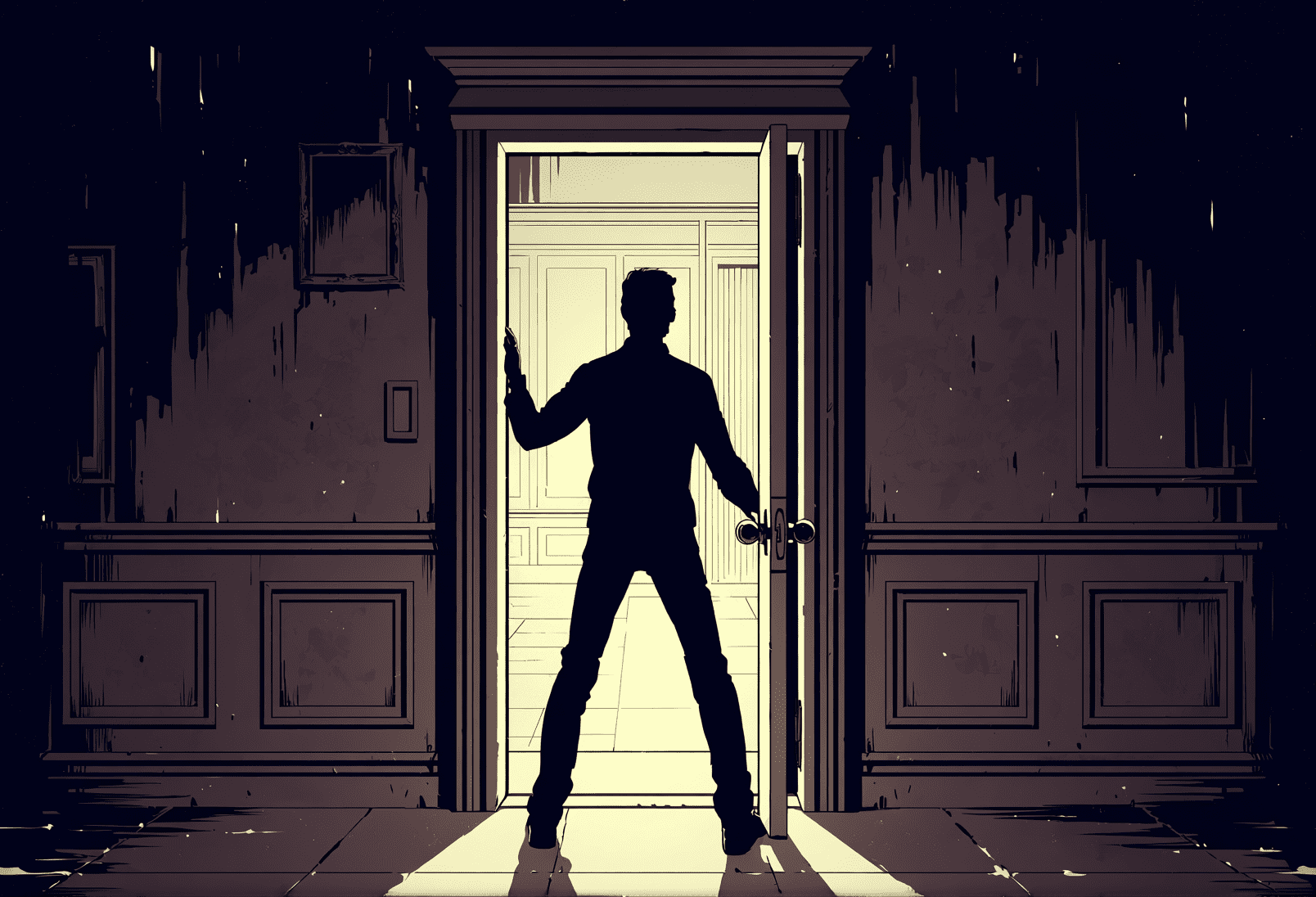
Put one person in a doorway and the whole room gets new rules.
The last craft article followed objects through a horror scene: a handrail, a lamp, a thermometer, and whatever ordinary thing has been assigned a deeply unreasonable amount of responsibility. This time, we are following the people. Specifically, who gets to move once somebody controls the exit.
That is scene blocking. It is the physical arrangement of bodies in a space, but you do not need a stage diagram or a tiny model of your characters glaring at each other across the furniture. You need to know where the door is, who can reach it, and who has to ask someone else to move.
Start with the threshold
A doorway is a useful little problem because it can only hold so much at once.
If one character stands in the middle of it, the other character cannot leave without getting closer, asking permission, pushing past, or finding another route. None of those choices is neutral. Even refusing to move becomes visible because now the refusal has a body in it.
The same thing works with stairwells, narrow halls, elevator doors, the space between a table and a wall, or one badly placed chair. Horror houses are full of architecture that should probably have been reported to somebody. You can use any of it!
Before you add atmosphere, decide what the threshold allows. Can two people pass each other? Does the door open inward or outward? Is there another exit? Can the person inside see what waits beyond it?
Those answers decide whether the moment reads as inconvenience, intimacy, protection, or threat.
Draw the blocking map before the dialogue
You do not need anything pretty. A box for the room and a line for the door will do. Then mark four things:
- Where each person begins.
- Who is closest to the exit.
- What has to move before anyone can leave.
- Who notices the arrangement first.
That last one is where the scene starts getting mean.
The person controlling the doorway may do it deliberately. They may also lean against the frame because they are tired, distracted, flirtatious, or spectacularly bad at noticing when they have turned themselves into a wall. The intention matters, but the effect exists either way. Somebody else has to decide whether to name it.
Now the dialogue has a second job. A harmless question can buy time. A joke can test whether the person will step aside. Silence can mean the trapped character has started measuring the room instead of listening.
Make every movement change the power
Give two characters one room and one visible exit.
Character A stands in the doorway. Character B takes one step toward it. If A moves aside, B has changed the scene without touching anyone. If A stays put, the distance between them becomes a decision. If A closes the door, the scene has acquired an entirely different problem and possibly a future police report.
You can keep the dialogue exactly the same through all three versions. The bodies will tell three different stories.
This is especially useful when a scene has started explaining itself. If the prose says one character feels trapped, check whether the room agrees. Maybe the exit is open and nobody stands near it. Maybe the character could leave without interruption. That can be intentional, but then the trap is emotional rather than physical and the page should know the difference.
If the room is supposed to hold them, make the route out cost something.
Let the body deliver the threat
Once the blocking is clear, look for sentences that repeat what the movement already said.
Suppose a character reaches for the handle and the other person places a hand flat against the door. You may not need another line explaining that the exit has been taken away. The hand did the work. Let it sit there being awful.
Then ask what the trapped character does with the information. Do they stop reaching? Look for another door? Step closer? Keep talking as if nothing happened?
The response is part of the blocking. A person who continues the conversation while quietly shifting toward a window is doing two things at once, and the reader gets to notice both.
This also keeps power from becoming a label pasted onto the scene. You do not have to tell us who controls the room if every attempt to move passes through the same body.
Try it on one scene
Take a conversation that already has tension and remove the dialogue for one pass.
Write down every entrance, exit, step, turn, touch, and change of distance. Circle the moment when somebody gains or loses a route out. If nobody does, choose one movement and let it alter the map.
Then put the dialogue back.
Keep the lines that fight with the physical action, expose it, or pretend not to notice it. Cut the lines that merely explain where the power sits. The door has one job now, and apparently it has chosen violence.
If you want the previous exercise, start with the objects in the room. Then choose a story from the Coda Languez story index and watch what happens around the door.